
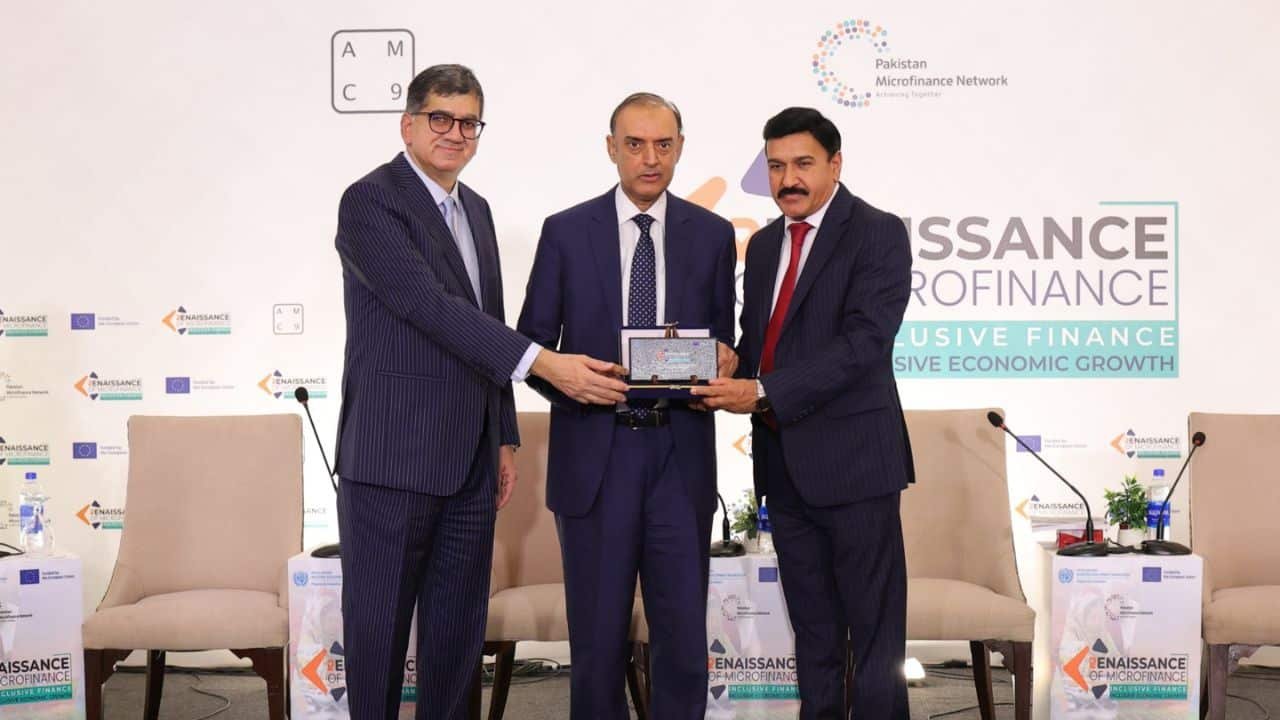
The 9th Annual Microfinance Conference (AMC-9), organized by the Pakistan Microfinance Network (PMN) in collaboration with the United Nations Industrial Development Organization (UNIDO) under the Poverty Alleviation and Inclusive Development Across Rural Sindh (PAIDAR) programme funded by the European Union, concluded with a strong call for innovation, resilience, and inclusive growth to define the future of Pakistan’s financial inclusion landscape.
Held under the theme “Renaissance of Microfinance,” the three-day conference brought together policymakers, regulators, development partners, microfinance providers, commercial banks, insurance providers, fintech innovators, and civil society leaders to discuss how microfinance can more effectively contribute to poverty reduction, resilience building, and inclusive economic growth.
The conference opened with an inaugural session focused on repositioning microfinance as a transformative engine for equitable prosperity. In his welcome address, PMN Chairman Amir Khan highlighted the need for renewed partnerships and innovation to strengthen the sector’s role in inclusive growth. Yasir Ashfaq, CEO of the Pakistan Microfinance Investment Company (PMIC), and Muneer Kamal, CEO & Secretary General of the Pakistan Banks Association, reflected on the evolution of microfinance in Pakistan and the need for deeper collaboration to address current economic challenges.
Speaking on behalf of the European Union, Carlo De Rosa, Development Advisor for Rural Development and Nutrition, underscored the EU’s long-standing commitment to advancing equitable growth in Pakistan. He emphasized that while grants are important, linking them to concessional and innovative financing tools is vital to ensuring access for women, youth, minorities, and landless farmers.
The inaugural plenary session explored the Macroeconomic Impact of Microfinance in Pakistan, with experts discussing its contributions to job creation, income generation, and resilience, while also identifying areas for reform such as product innovation, micro-savings, and integration with digital finance.
The day concluded with two significant launches aimed at expanding access to finance. The Asian Development Bank introduced its USD 30 million Credit Guarantee Facility under the Women Inclusive Finance programme, designed to de-risk lending to women entrepreneurs and micro-enterprises. Additionally, UNIDO and its partners launched a Guarantee-Based Blended Finance Facility for Rural Enterprises to catalyze credit access for underserved communities through a mix of grants, concessional loans, and guarantees.
Day two featured a high-impact debate on “Mission Drift in Microfinance”, where sector leaders reflected on whether microfinance has strayed from its original poverty-alleviation mission or evolved to meet broader financial inclusion goals. Participants called for a renewed focus on marginalized groups, increased investment in rural and agricultural finance, and the use of technology to scale outreach.
A regulatory dialogue with the Commissioners of the Securities and Exchange Commission of Pakistan (SECP) Mr. Zeeshan Khattak and Mr. Mujtaba Lodhi, reaffirmed the regulator’s commitment to promoting inclusive financial services, enhancing microinsurance, and supporting innovation through flexible regulatory frameworks.
Subsequent plenary sessions examined strategies for navigating macroeconomic and climate-related risks and highlighted the importance of building disaster-responsive products and diversifying funding sources. A dedicated session on “Women’s Financial Inclusion: From Barriers to Breakthroughs” showcased innovative financial solutions designed to close gender gaps, demonstrating that women’s financial empowerment has ripple effects across households and communities.
The final day of AMC-9 focused on designing inclusive financial products, leveraging digital public infrastructure, and unlocking finance for rural enterprises. Panelists emphasized the importance of digital platforms like Raast, data-driven decision-making, and blended finance approaches to address inclusion gaps.
A fireside chat between Mr. Amir Khan, Chairman PMN and Mr. Saleem Ullah, Deputy Governor State Bank of Pakistan (SBP) underscored the need for adaptive financial solutions for smallholder farmers, microenterprises, and climate-affected communities. Speakers emphasized that digital innovation, research-driven product design, and value-chain financing are critical to deepening the impact of microfinance in the coming decade.
One of the most anticipated moments of AMC-9 was the launch of “Sindh’s Financial Landscape: A Step Towards Promoting Inclusive Finance.” Developed under the EU-funded PAIDAR Programme in collaboration with PMN, the study offers a comprehensive overview of financial access barriers, demand-side gaps, and structural constraints in rural Sindh. It calls for coordinated efforts to bridge the gap between formal and informal finance, unlock new blended finance models, and design tailored products for women, youth, minorities, and micro, small, and medium-sized enterprises (MSMEs).
In his keynote address, State Bank of Pakistan Governor Jameel Ahmad emphasized the critical role of macroeconomic stability in enabling inclusive growth. He highlighted significant progress in stabilizing inflation, strengthening foreign exchange reserves, and shifting prudential regulations for microfinance banks to a more principle-based framework. These reforms include the introduction of new loan categories for agriculture and livestock and enhanced lending limits, which are expected to boost financial access for underserved segments.
“Economic growth is meaningful when it is durable and inclusive”, Mr. Jameel Ahmad said. He underscored the importance of public-private collaboration, applauded the industry’s innovative efforts, and noted that inflation has declined sharply – creating fiscal space for stable, long-term reforms.
At the closing ceremony, Chief Minister Syed Murad Ali Shah reaffirmed the provincial government’s commitment to inclusive finance as a driver of socio-economic development. He highlighted successful models such as the People’s Poverty Reduction Program (PPRP), which have mobilized over one million households and provided more than 170,000 women with credit to launch enterprises.
Welcoming the launch of the Sindh’s Financial Landscape study, he noted that the findings would guide future policy and investment decisions: “Our vision is a Sindh where every enterprising woman and man can access finance, build livelihoods, and contribute to shared prosperity.”
AMC-9 concluded with a shared commitment from all stakeholders to implement the conference’s recommendations and accelerate financial inclusion.
About the Author
Written by the expert legal team at Javid Law Associates. Our team specializes in corporate law, tax compliance, and business registration services across Pakistan.
Verified Professional
25+ Years Experience