
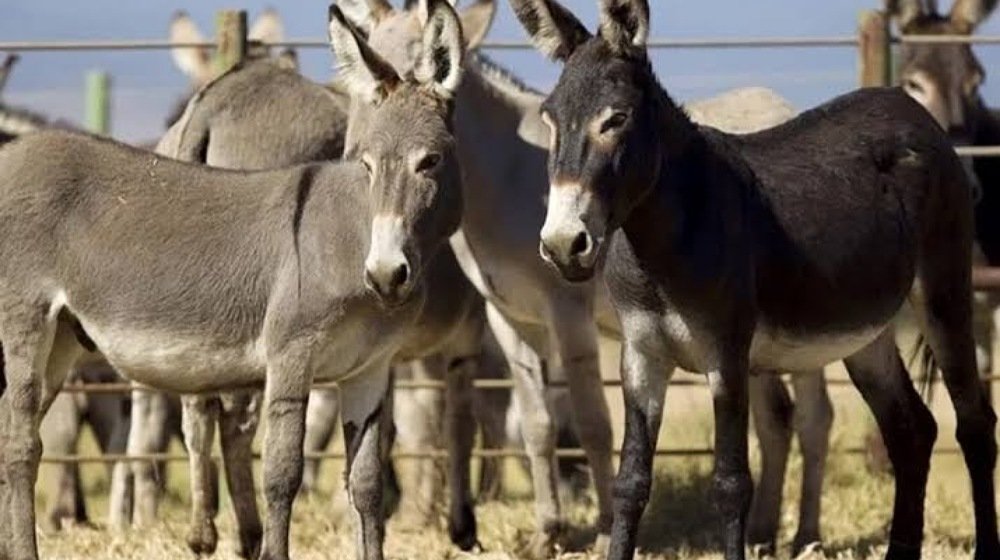
The China-Pakistan Donkey Industry Development Forum was held in Islamabad today under the theme “Creating Opportunities Together, Winning the Future Together.”
The forum was co-hosted by the China Chamber of Commerce in Pakistan and Sangyang Industrial (Beijing) Group Co., Ltd., with guidance from the Embassy of the People’s Republic of China in Pakistan and Pakistan’s Ministry of National Food Security & Research. It brought together hundreds of participants, including government officials, researchers, business leaders, and scholars from both countries, to explore innovative and sustainable avenues for industry growth.
Opening the forum, senior officials from both governments underscored the strategic importance of the donkey industry in addressing evolving market needs and promoting specialized livestock farming.
Among the distinguished speakers were Secretary of Pakistan’s Ministry of National Food Security & Research Amir Mohyuddin, Chargé d’Affaires at the Chinese Embassy in Islamabad Shi Yuanqiang, and Wang Huihua, Chairman of the China Chamber of Commerce in Pakistan. Their remarks emphasized the need for standardization, scalability, and industrialization of the sector to ensure long-term viability and mutual benefit.
The forum featured a series of sessions led by experts and academics who presented research on donkey breeding, genetic resource conservation, and value-added utilization of donkey by-products. Discussions also explored supply chain digitalization and modern branding strategies to enhance market competitiveness. Participants highlighted technological innovation, smart breeding techniques, and sustainable practices as essential to improving efficiency and expanding the industry.
In his remarks, Shi Yuanqiang noted that collaboration in the donkey industry could serve as a new pillar of economic partnership between China and Pakistan. He described the forum as a step toward agricultural modernization and rural development, aligned with the broader development goals of both countries.
To promote transparency and ethical practices, Pakistan’s Ministry of National Food Security & Research issued a policy statement on export regulations, industry oversight, and measures to curb illegal slaughter and smuggling. The China Chamber of Commerce in Pakistan also released a Donkey Industry Self-Regulation Declaration, pledging to uphold local laws, respect cultural and religious values, ensure fair labor standards, and support community development.
The forum also saw the signing of multiple cooperation agreements, including a Letter of Intent between the Pakistan Agricultural Research Council (PARC) and Sangyang Industrial (Beijing) Group, and a Memorandum of Understanding (MoU) to establish the China-Pakistan Joint Laboratory for Donkey Industry Innovation. Further MoUs involved the Cholistan University of Veterinary and Animal Sciences and various Chinese industry partners.
Wen Ming, CEO of Sangyang Industrial, outlined the company’s roadmap for developing Pakistan’s donkey sector through a contract farming model. He expressed hope that, under the guidance of the Chinese Embassy and in partnership with Pakistani institutions, the industry could become a high-quality, sustainable, and eco-friendly component of the national economy.
Delivering the keynote address, Professor Zeng Shenming of China Agricultural University stressed the importance of data-driven decision-making, advanced breeding programs, and the integration of new technologies to boost productivity and competitiveness. He called technological innovation the cornerstone of sustainable development in the sector.
The forum concluded with a strong sense of shared commitment from both countries to deepen agricultural cooperation. Participants agreed on the need to strengthen dialogue, build consensus, and jointly drive technological and business innovation. They emphasized that these efforts could contribute significantly to rural prosperity, improve the livelihoods of Pakistani farmers, and meet the growing demand for sustainable livestock products in both domestic and international markets.
Editorial & Legal Practice Group
Authored and reviewed by the corporate law and tax litigation practice group at Javid Law Associates. Our team comprises High Court advocates, corporate legal advisors, and authorized tax practitioners across Pakistan.
Advocates High Court & Tax Counsel
Jurisdiction: Pakistan