
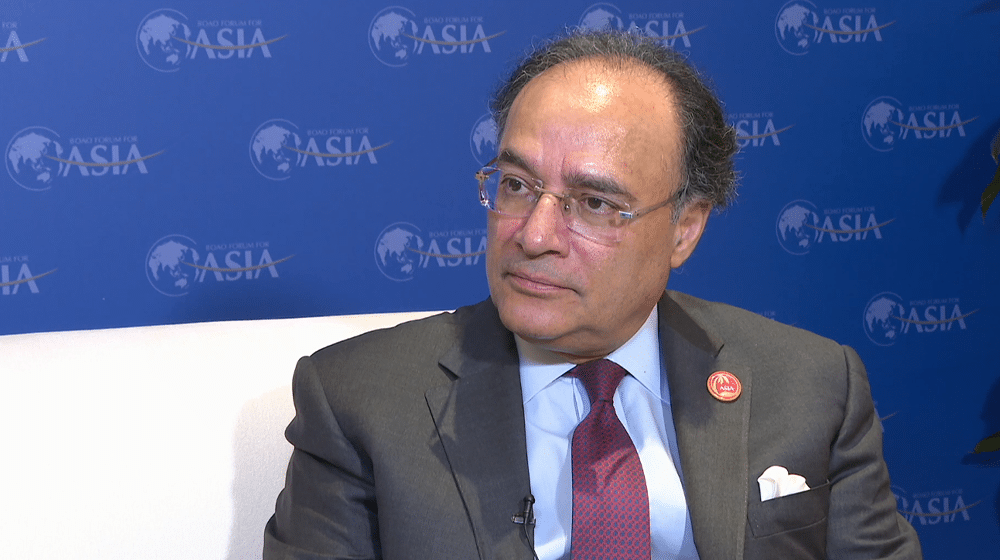
Finance Minister Muhammad Aurangzeb said mining, agriculture and IT services will play a big role in expanding trade and eventually doubling Pakistan’s exports to $60 billion in 3-5 years.
Aurangzeb said this in an interview with Asharq and Bloomberg on the sidelines of the AlUla Conference for Emerging Market Economies 2025.
“So in Pakistan’s case, obviously China has been a very big corridor for us with respect to the Belt and Road Initiative. Going forward I see GCC where we are sitting right now, we see huge export potential in these markets and we are doing already a reasonable chunk in terms of, but going forward the potential, it’ll be mining, agriculture, and IT services. So in numbers where our ambition is that we are at roughly about $30 billion+ in terms of exports and we want to double in the next three to five years,” he said.
Aurangzeb highlighted improvements in inflation, interest rates, foreign exchange reserves, and currency stability, which have contributed to renewed institutional inflows.
The Finance Minister underscored the government’s focus on using this stability to drive key reforms in taxation, energy, and state-owned enterprises, with a push toward privatization. “We are using this macroeconomic stability to execute structural reforms, which are in the context of taxation, energy, state-owned enterprises to move them towards privatization, and then reducing the size of the federal government and therefore focusing on our public finances,” he stated.
He also stressed the need to streamline the federal government and ensure prudent fiscal management to prevent a recurrence of past twin deficits. He noted that Pakistan currently has both a current account and a primary surplus, providing fiscal space to support sustainable growth.
“Both the current account is in a surplus, we have a primary surplus at this point in time. We want to now consolidate and use this and the fiscal space which is available to prioritize the expenditures which can then help the growth trajectory as we move forward,” he added.
Discussing trade and investment, Aurangzeb pointed to regional connectivity as a crucial engine for economic expansion. As mentioned above, he acknowledged China’s role in Pakistan’s trade corridors through the Belt and Road Initiative while identifying the Gulf Cooperation Council (GCC) markets as a major opportunity for export growth.
About the Author
Written by the expert legal team at Javid Law Associates. Our team specializes in corporate law, tax compliance, and business registration services across Pakistan.
Verified Professional
25+ Years Experience