
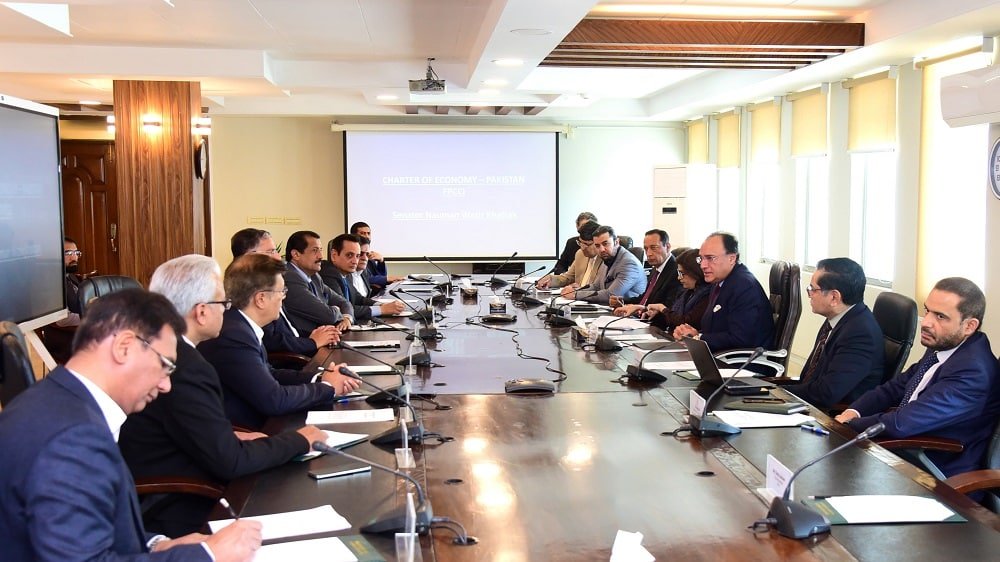
A meeting was held today between Federal Minister for Finance Senator Muhammad Aurangzeb and a delegation from the Federation of Pakistan Chambers of Commerce & Industry (FPCCI), led by Atif Ikram, President FPCCI, S. M. Tanveer, Patron-in-Chief, and Senator Noman Wazir, Chief Executive of FF Steel, KPK.
The meeting aimed to share a comprehensive Charter of Economy prepared by FPCCI with the minister and his team. The FPCCI team emphasized that this Charter was developed to foster political consensus and intended to meet with all stakeholders, including political parties, to form an effective economic strategy that transcends political divides and addresses Pakistan’s economic challenges.
Their goal is to free the country from its economic calamities by prioritizing the nation’s development and economic growth, particularly to meet the needs of the growing population, especially the youth, who form the core of Pakistan’s demographic structure.
Senator Noman Wazir Khattak provided a detailed presentation on the proposals and recommendations outlined in the Charter of Economy. The key recommendations included the reorganization of specialized civil services with the establishment of dedicated groups in critical sectors such as Energy, Finance, Industry, and Health to lead policy formulation and ensure informed decision-making.
The Charter also called for embracing solar and wind energy, seen as the cheapest sources of power, and proposed keeping wheeling charges for the Competitive Trading Bilateral Contract Market (CTBCM) at a maximum of Rs 4 per KWh. The presentation also emphasized a greater focus on regional trade and development financial institutions, with proposals for at least 20% of lending directed toward long-term CAPEX and 10% toward startup CAPEX.
A stable exchange rate was recommended to support exports and discourage imports that do not comply with the Pakistan Standards and Quality Control Authority (PSQCA). The Charter also stressed the importance of a uniform gas pricing structure for industries across the country to promote industrial growth.
Further recommendations included transferring ownership of State-Owned Enterprises (SOEs) to employees, allowing them to manage these enterprises or privatize them, and converting their pension funds into equity.
The presentation proposed strategic reforms on various fronts, including debt management, trade partnerships, tax compliance, energy efficiency, and the exploitation of mineral resources. It also called for a progressive taxation model for agriculture, better governance structures, pension and welfare reforms, digitalization, and improvements to the bankruptcy laws in Pakistan.
Senator Aurangzeb welcomed the FPCCI delegation and praised their efforts in preparing a comprehensive and timely Charter of Economy, noting that such initiatives are crucial at this juncture, even when political parties agree on a common set of economic goals.
He reflected on his previous involvement in the preparation of a similar Charter of Economy by the Pakistan Business Council in 2020, highlighting the importance of uniting all stakeholders on a common platform to address the challenges of declining living standards and achieve sustainable economic growth. The minister reiterated that quick fixes would not suffice, and a steady, unified effort was required to drive Pakistan’s economic recovery.
In his response, the minister also briefed the delegation on the ongoing reforms in key sectors, including macroeconomic stability, taxation, energy, and rightsizing of the federal government. He reassured the delegation that the government was committed to resolving pressing issues, such as energy costs for industries, to foster industrialization and export-led growth, in line with the government’s economic vision.
The members of the FPCCI delegation expressed their appreciation for the minister and his team’s efforts in improving Pakistan’s economic indicators and hoped that the government would continue addressing critical issues to support industrialization and economic growth in the country.
Editorial & Legal Practice Group
Authored and reviewed by the corporate law and tax litigation practice group at Javid Law Associates. Our team comprises High Court advocates, corporate legal advisors, and authorized tax practitioners across Pakistan.
Advocates High Court & Tax Counsel
Jurisdiction: Pakistan