
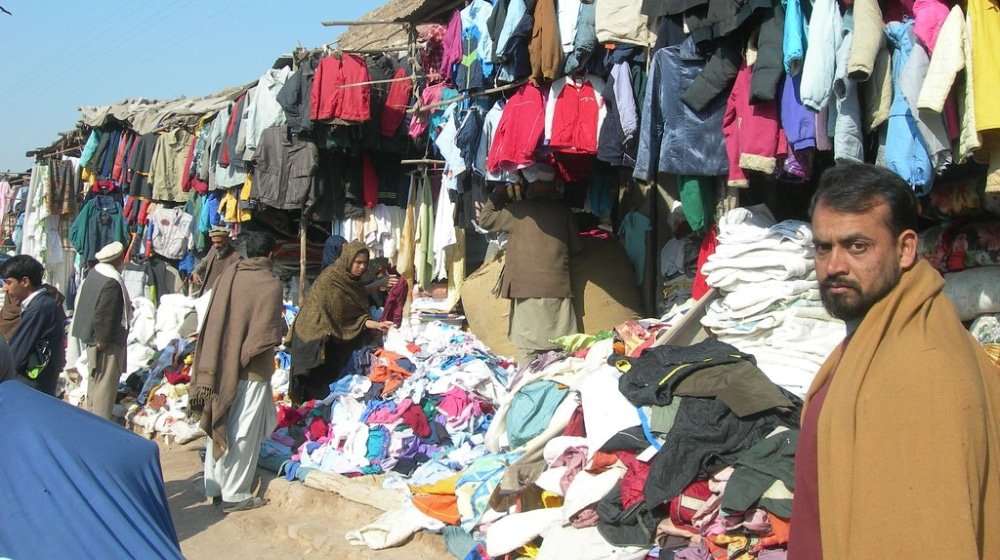
Pakistan’s imports of second-hand clothing have surged to an unprecedented 1.137 million tonnes, valued at $511 million, in the previous fiscal year, breaking the earlier record of 990,266 tonnes ($434 million) in FY24.
This significant increase highlights the rising demand for affordable clothing amid the country’s deepening poverty crisis.
With nearly 45% of Pakistan’s population now living below the poverty line, according to the World Bank’s latest report, second-hand clothing markets, commonly known as landa bazaars or flea markets, have become a lifeline for millions.
The World Bank’s report highlights a grim reality: the poverty threshold has been raised to $4.20 per person per day, up from $3.65, pushing the poverty ratio for lower-middle-income groups to 44.7%, compared to 39.8% under the previous benchmark.
Muhammad Usman Farooqui, General Secretary of the Pakistan Second-Hand Clothing Merchants Association (PSHCMA), attributes the surge in second-hand clothing imports to escalating poverty. “Families from lower and middle-income brackets are increasingly dependent on affordable used goods,” Farooqui said.
Farooqui has urged the government to reduce taxes and duties on second-hand clothing imports, which he argues are making these goods unaffordable for those who need them most. Currently, these imports are subject to a 10% regulatory duty, 5% customs duty, 6% advance income tax, and approximately 5% sales tax.
In addition, traders face a 5% sales tax on the difference between their purchase and sale prices, while domestic traders earning over Rs. 600,000 annually are liable to pay income tax. The Finance Bill 2024 has further complicated matters by designating second-hand clothing importers as withholding agents, requiring them to collect advance tax at 0.1% from distributors, dealers, and wholesalers. For non-compliant retailers, this tax rises to 2% or even 2.5%.
Farooqui noted that many individuals in the used clothing trade are unregistered with the Federal Board of Revenue (FBR) and lack fixed business locations or proper records, making compliance with these regulations difficult.
Used clothing is primarily imported from Europe, the USA, Japan, Korea, China, and Canada. Exporters in Pakistan’s special zones dominate 60-70% of these imports, sorting through unsorted clothing to extract higher-quality items for re-export, with only 10-20% sold locally.
Import duties on used clothing stand at Rs. 36 per kg, while shoes are taxed at Rs. 66 per kg. Farooqui stressed that reducing these taxes could provide much-needed relief for Pakistan’s disadvantaged segments.
Market surveys reveal the high prices of second-hand goods. Imported used jeans cost between Rs. 300-400, while a second-hand shirt is priced at Rs. 250-300. In contrast, new sports shoes made in Lahore cost Rs. 2,500-3,500, while branded shoes from Vietnam or China are priced at Rs. 4,000-5,500. Used sports shoes, however, are available for Rs. 600-800, making them a more accessible option for many.
About the Author
Written by the expert legal team at Javid Law Associates. Our team specializes in corporate law, tax compliance, and business registration services across Pakistan.
Verified Professional
25+ Years Experience