
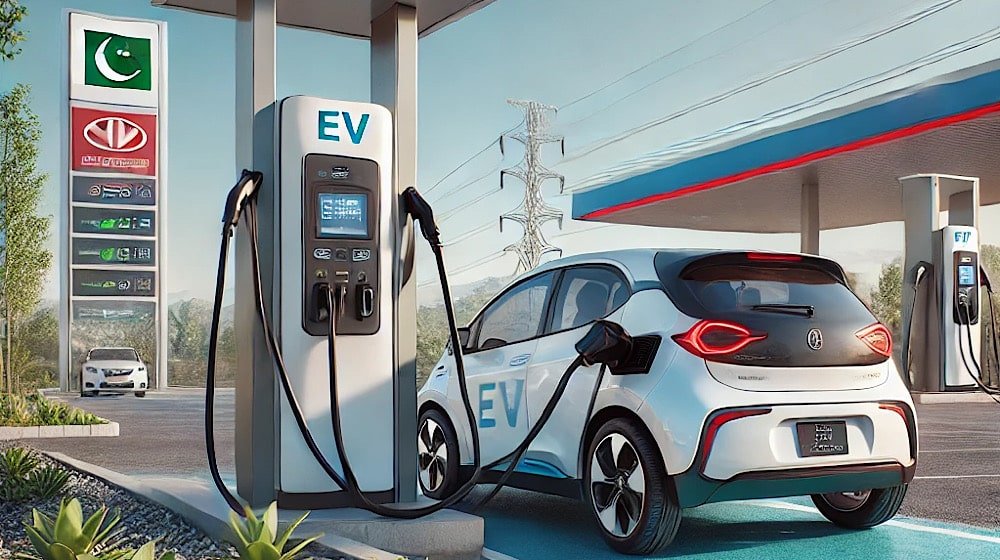
The Pakistan Institute of Development Economics (PIDE) has recommended targeting 10% of all vehicles as electric vehicles (EVs) by 2030.
In its recommendations for the upcoming Electric Vehicle (EV) Policy, PIDE has presented a comprehensive framework titled ‘Future on Wheels’ to support the development of an effective policy in response to the Prime Minister’s call for a robust EV policy.
These recommendations are based on insights from PIDE’s recently published books on Pakistan’s automobile industry: ‘Driving Backwards: What is Wrong with Pakistan’s Automobile Industry?’ and ‘Wheels of Change: Tracing Pakistan’s Automotive Evolution through Political Economy and Technology Acquisition.’
PIDE has proposed a long-term policy for the development of the EV industry in Pakistan, with specific short-term, medium-term, and long-term goals. The short-term targets for 2030 include ensuring that 10% of all new 4-wheelers and 25% of all new 2/3-wheelers sold are EVs. By 2040, these shares should increase to 50% for 4-wheelers and 75% for 2/3-wheelers. Additionally, PIDE recommends that by 2035, 50% of all new 4-wheelers and 2/3-wheelers produced in Pakistan should be EVs.
The policy emphasizes integrating Pakistan’s automobile industry into the global value chain, particularly for EVs. To achieve this, PIDE suggests lowering customs duties on the import of EV inputs and significantly increasing the production of EVs and their components to boost exports. By 2030, 10% of all EVs and 5% of auto parts produced in Pakistan should be exported, with the goal of exporting 50% of all EVs and auto parts by 2040.
To facilitate this transition, the government is urged to promote joint ventures between local automotive firms and foreign companies to enhance EV production through Transfer of Technology (ToT) and capital investment. Engagements on a Government-to-Government (G2G) and Government-to-Business (G2B) basis should also be pursued to attract investment and manufacturing opportunities in Pakistan.
The State Bank of Pakistan (SBP) is encouraged to devise a Green Financing Plan to provide financing through commercial banks for the growth of EVs and their components. This plan should focus on establishing new manufacturing facilities, expanding existing ones, and setting up EV charging infrastructure.
PIDE also highlights the importance of Research & Development (R&D) in EV technology and related areas to position Pakistan as a global player in the EV transition. It recommends establishing a research fund to support targeted R&D activities, particularly in reducing EV production costs, reusing batteries after their initial lifecycle, and ensuring environmentally safe battery waste disposal.
By implementing these recommendations, PIDE envisions a sustainable and competitive EV industry in Pakistan that contributes to economic growth, environmental sustainability, and integration into the global EV market.
Editorial & Legal Practice Group
Authored and reviewed by the corporate law and tax litigation practice group at Javid Law Associates. Our team comprises High Court advocates, corporate legal advisors, and authorized tax practitioners across Pakistan.
Advocates High Court & Tax Counsel
Jurisdiction: Pakistan