
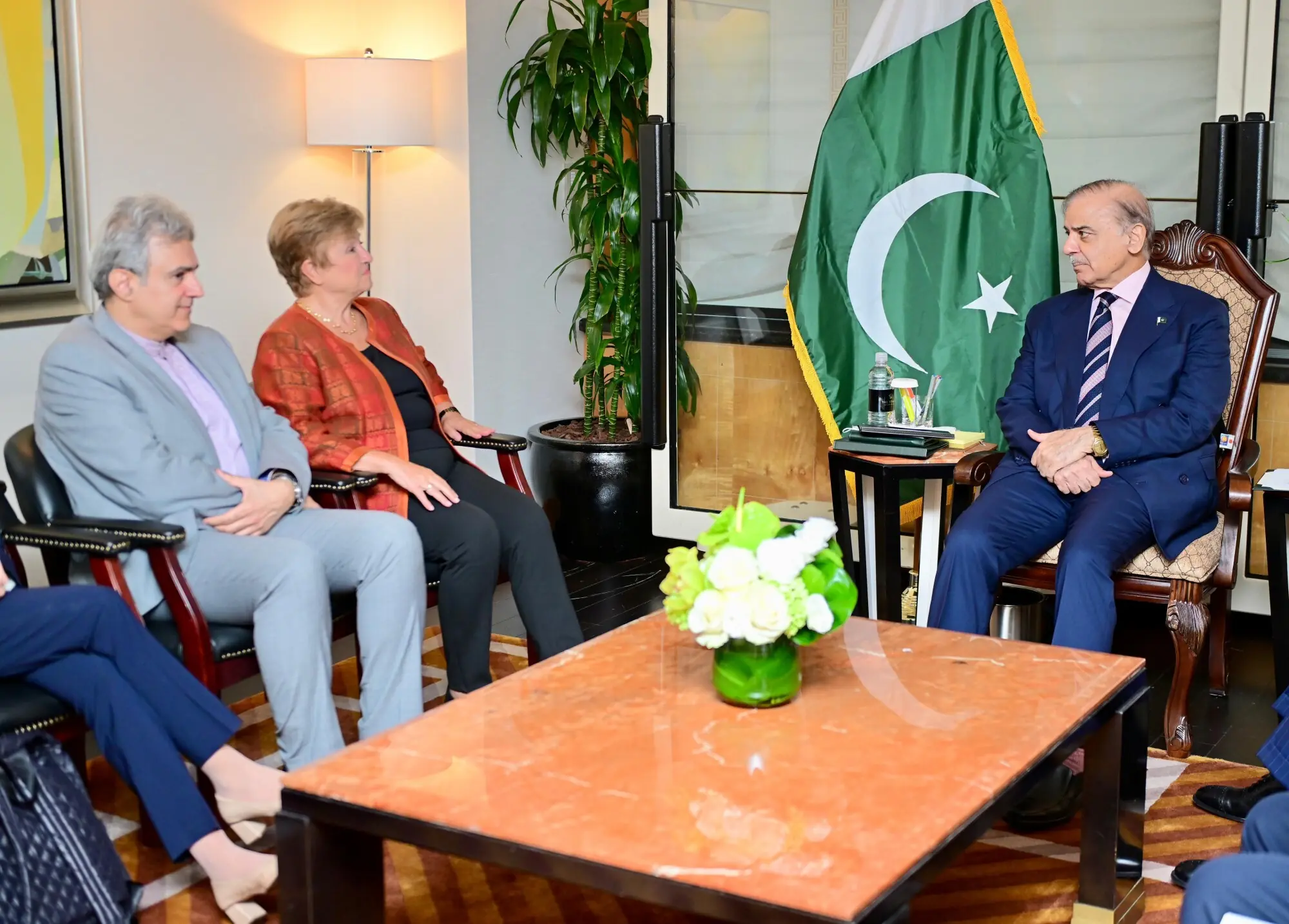
Prime Minister Shehbaz Sharif held separate meetings with International Monetary Fund (IMF) Managing Director Kristalina Georgieva and World Bank President Ajay Banga on Wednesday, on the sidelines of the 80th United Nations General Assembly session, to discuss Pakistan’s ongoing economic reforms and future cooperation with both institutions.
In his meeting with Georgieva, the prime minister praised the IMF’s longstanding partnership with Pakistan, which he said had been strengthened under her leadership. He acknowledged the IMF’s timely support through various programs, including a $3 billion Stand-By Arrangement for fiscal year 2024, a $7 billion Extended Fund Facility (EFF), and a $1.4 billion Resilience & Sustainability Facility (RSF).
“Today, Pakistan’s economy, bolstered by deep-rooted structural reforms, is showing positive signs of stabilization and is on the path to recovery,” Sharif said, according to a statement from his office. He emphasized that Pakistan was making steady progress in meeting IMF program targets, but stressed that the impact of recent floods on the country’s economy should be taken into account during the IMF’s upcoming review.
An IMF team is set to visit Pakistan on September 25, 2025, to conduct the second semi-annual review of the EFF, which will assess the country’s economic performance for the March and June 2025 quarters. A successful review would clear the way for the IMF Board to approve a $1 billion tranche, bringing total disbursements under the program to over $2 billion.
Georgieva expressed sympathy for the victims of the recent floods and stressed the importance of a comprehensive damage assessment to guide recovery priorities. She also reaffirmed the IMF’s continued support for Pakistan’s economic reforms.
In his meeting with Ajay Banga, Prime Minister Sharif commended the World Bank’s transformative leadership under Banga, acknowledging the institution’s efforts to become a faster, more efficient development partner. Sharif highlighted the World Bank’s longstanding support to Pakistan, particularly during the COVID-19 pandemic and the catastrophic 2022 floods.
The prime minister briefed Banga on Pakistan’s comprehensive reform agenda, which includes resource mobilization, energy sector reforms, privatization, and measures to combat climate change. “These reforms are stabilizing Pakistan’s macroeconomy, restoring investor confidence, and promoting sustainable, inclusive growth,” Sharif said.
Banga expressed appreciation for Pakistan’s reform efforts and reaffirmed the World Bank’s readiness to continue supporting the country’s development priorities. The two leaders also discussed the World Bank’s new Country Partnership Framework (2026–2035), which includes an unprecedented $40 billion commitment for Pakistan.
The prime minister reiterated Pakistan’s commitment to ensuring the effective implementation of the partnership framework in close collaboration with provincial governments, stressing its importance for the country’s long-term economic development.
About the Author
Written by the expert legal team at Javid Law Associates. Our team specializes in corporate law, tax compliance, and business registration services across Pakistan.
Verified Professional
25+ Years Experience