
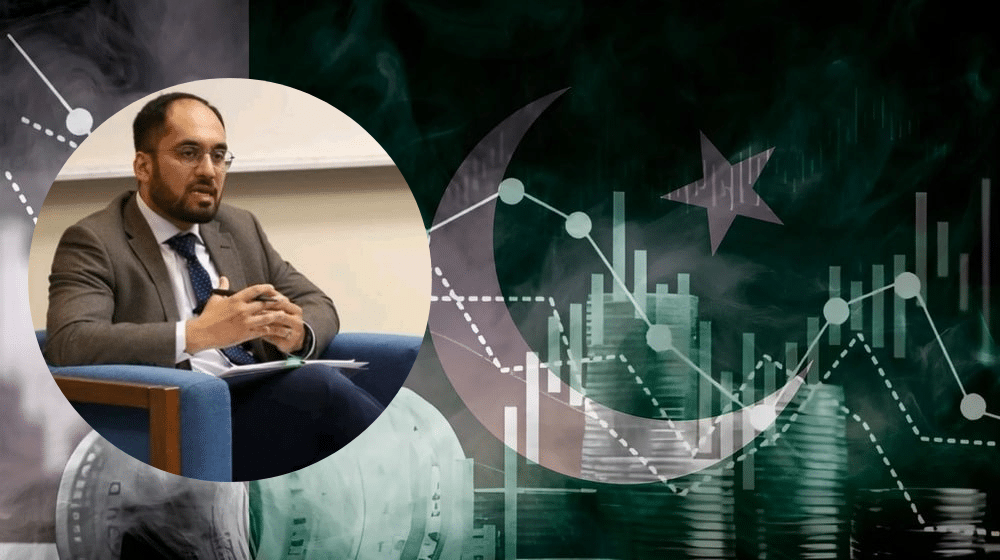
Pakistan’s steep currency depreciation over the last four decades has not helped exports because the rupee has never been managed in a consistent and predictable way.
This warning and analysis has come from Dr Ali Hasanain, Head of Economics at LUMS, in a long thread posted on X (ex-Twitter).
He stated that the popular belief that the dollar jumped from Rs. 100 to Rs. 300 but exports did not increase is built on a misunderstanding.
Exchange rate comparisons must account for inflation at home and in trade partner countries.
That is why economists track the Real Effective Exchange Rate, which measures the value of the rupee against trading partners after adjusting for price changes.
The dollar was priced at Rs. 3.30 in 1947. It rose to Rs. 9.90 in 1980. It crossed Rs. 21 in 1990. It stood near Rs. 52 to Rs. 58 in 2000. It averaged Rs. 84 in 2010.
It reached Rs. 154 in 2020. It touched almost Rs. 300 in 2023 before official intervention. However, exports as a share of GDP fell.
They peaked at almost seventeen point three percent in 1992 and dropped to eight point two percent in 2017. They are only near ten percent today.
According to Dr Hasanain this does not mean the exchange rate policy failed. It means Pakistan never pursued a competitive currency policy in a steady manner.
The rupee was repeatedly kept stronger than economic fundamentals allowed. When foreign reserves thinned and global lenders stepped in, the rupee crashed suddenly.
The average depreciation over four decades equals 0.6% per month. But instead of small planned adjustments, Pakistan experienced violent swings.
Sudden falls of five percent within a month occurred repeatedly. Calm periods, such as 2000 to 2007 and 2013 to 2017, were followed by deep instability.
Dr Hasanain explained that a softer rupee can encourage exports if businesses can plan around it for years. Sudden crashes do the opposite by destroying confidence and increasing uncertainty.
He stressed that a competitive exchange rate must work together with industrial support, energy reforms, and easier business procedures.
Pakistan should not wait for everything to improve before correcting the currency. But export gains would be stronger if these reforms move together, he added.
The economist concluded that the rupee did not boost exports because it was not used as a long-term tool to shape incentives, but was allowed to fall only at the point of crisis when the music stopped.
Editorial & Legal Practice Group
Authored and reviewed by the corporate law and tax litigation practice group at Javid Law Associates. Our team comprises High Court advocates, corporate legal advisors, and authorized tax practitioners across Pakistan.
Advocates High Court & Tax Counsel
Jurisdiction: Pakistan